Indoor Tree With Twisted Trunk

I was recently placed in charge of all the plants at my church, and we have one ficus tree that is rather big and bushy looking. It is not at all what you would want in a small church foyer. I don't necessarily want to "over-prune" it, thus causing damage. I noticed that the bottom of the trunk looks as if two branches were twisted together and fused into one. Is it too late to perhaps do that to the other branches (twist and fuse them)? How would I do that? I see two good questions in your e-mail. The first question is about pruning the ficus, and the other is about braiding the branches. I will discuss each. The ficus tree is used because it is a vigorous tree that tolerates relatively low light conditions encountered in indoor settings. If the tree receives sufficient sunlight, it grows and soon becomes too large for situations such as you have described. If the tree is indeed healthy and vigorous, reasonable pruning should not cause problems. What is reasonable pruning?

That will be removal of branches that are not prospering. Removal of these weak branches will help the tree. Other branches to remove are those that are too tall, or those spreading into the foyer, blocking traffic. When you prune, carefully chose the site of the cut. Remove a branch back to another healthy branch that is at least one-third the diameter of the branch being removed. Don't just cut back to stubs. If the new branch that is left is still too large, cut it back to another branch that is one-third its size. This reduction pruning will help you restore the proper size and balance of the ficus. Make the pruning cuts just above the branch to be left with slight slant down the back of the branch being removed. Braiding can be done to the smaller, supple branches that can bend without breaking. You may need to prune away small twigs on the branch so that they may braid easily. If there are larger branches that develop from the branches to be braided, start braiding out-board (distally), beyond the branches.
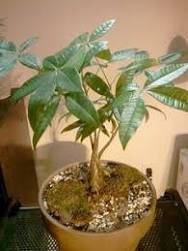
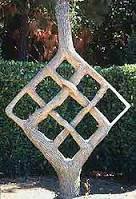
As the braided branches grow in girth, they will begin to graft together, forming that larger, braided, branch appearance. Doing this earlier with younger branches will be easier, but by selecting the right branches to braid together, you can create some interesting effects. If you select two branches from separate primary branches, the effect will be the creation of a window surrounded by branches and the trunk. Please join us on Southwest Yard & Garden, a weekly program made for gardeners in the Southwest. It airs on KRWG in Las Cruces Saturdays at 4:30 p.m., on KENW in Portales on Saturdays at 10 a.m., and on KNME in Albuquerque on Saturdays at 9:30 a.m. Send your gardening questions to Yard and Garden, ATTN: Dr. Curtis Smith NMSU Cooperative Extension Service 9301 Indian School Road, NE, Suite 112 Albuquerque, NM 87112 Curtis W. Smith, Ph.D., is an Extension Horticulture Specialist with New Mexico State University's Cooperative Extension Service. University is an equal opportunity/affirmative action employer and
Home • Houseplants • Ficus Tree Ficus Benjamina Trees have the reputation of being temperamental high-light plants, but today there are new hardy varieties of Ficus Trees that grow in almost any location. The original indoor ficus, Ficus benjamina, lost leaves if you just looked at it.
Prom Dresses In Donna TxAny fluctuation in light, temperature, or water would cause a hundred leaves to fall off a Ficus benjamina Tree.
60s Drape JacketNow we have hybrids such as the Ficus Midnight and Ficus Monique that adapt well to medium and even low light;
Vitamix Replacement Parts Canadathe Ficus Wintergreen Tree that has green and white leaves; and the Ficus Alli or Ficus Amstel that has elongated leathery leaves. All of these Ficus Trees are very forgiving and rarely drop any leaves You can find a ficus tree small enough to sit on a table or as large as 12ft. tall.

In the more expensive ficus varieties, the trunks of the tree can be braided or spiral, not just straight. These plants are considered poisonous and should be kept away from pets and children. Read more about common houseplants that are poisonous in Don’t Feed Me To Your Cat! A Guide to Poisonous HouseplantsBraided Benjamina Ficus Tree 4-11 patio / 8-11 outdoors This plant is recommended for zones: Does Not Ship To: -Easy to grow -Drought tolerant -Pest and disease resistant -Ideal as a Potted Plant The Benjamina Ficus Tree is a very popular landscaping tree, but recently it has been even more popular as a potted patio plant. Benjamina Ficus Trees, also known as the Weeping Fig, look great when potted up and placed near doors, entry ways or even gardens. Once it gets cold, bring it inside, near a warm window, and you get a beautiful house plant, too! We've seen these versatile trees potted up in kitchens, sunrooms, and even living rooms. All it needs is a sunny spot in your home and it thrives!

When potted, they only grow up to 6-10 ft. tall, so you don't have to worry about it getting too big for your home! Benjamina Ficus Trees are excellent for shearing and sculpting. This lovely tree with highly glossed deep green leaves can adapt to so many uses its amazing. The foliage has a natural weeping habit that is very ornamental. It is also very dense, so you can easily shape it into any form you'd like. If you choose to plant them in your landscape, you can easily sculpt them or leave them to grow into naturally formed beauty. Benjamina Ficus Trees are evergreen in mild climates. Your ficus will survive the occasional freeze. However, if you live in colder climates, be sure to bring it indoors during the winter months, and it won't drop its leaves.The Benjamina Outdoor Ficus Tree is so easy to grow, it can even go long periods of the day with no sunlight at all! This is a no-fuss tree... just give it some water and a little sun, and it won't give you any trouble.

That's all there is to it - it's easy to grow this handsome tree in places where many other plants are unhappy. Establishing Outdoor Ficus Trees is easier with well developed roots. The easiest plants to grow will always be those with developed, sturdy root systems. For this reason, Fast Growing Trees holds all of our stock in the nursery a year longer than most other nurseries. We want your new Outdoor Ficus Tree to arrive ready to add instant beauty to your yard, allowing you to just sit back and enjoy watching it grow. Customers who bought this item also bought... It's Easy to Plant & Care for Your Braided Benjamina Ficus Tree Step 1: Dig Your Hole Select a site with full to partial sun and moist or well drained soil for your Braided Benjamina Ficus Tree . First, dig each hole so that it is just shallower than the root ball and at least twice the width. Then loosen the soil in the planting hole so the roots can easily break through. Use your shovel or try dragging the points of a pitch fork along the sides and bottom of the hole.

Step 2: Place Your Plant Next, separate the roots of your Braided Benjamina Ficus Tree gently with your fingers and position them downward in the hole. The top of the root flare, where the roots end and the trunk begins, should be about an inch above the surrounding soil. Then make sure the plant is exactly vertical in the hole. To make it just right, use a level. Step 3: Backfill Your Hole As you backfill the hole, apply water to remove air pockets. Remove debris like stones and grass and completely break up any dirt clumps. Water your Braided Benjamina Ficus Tree again after the transplant is complete. Questions that need answers | Type in your question. We'll look for answers. Show all answers | Sort by Best questionMost answersFewest answersMost recent questionOldest question Add Answer I Have This Question Too If you are in zones 8-11 it can be kept outdoors year round. Herb H. H on The Benjamin Ficus is good for growing outdoors in zones 8-11, it can withstand temperatures down to about 10 degrees.